For one brief window, the market convinced itself that software engineering had collapsed into prompting. Describe the product in English. Let the model generate the stack. Refresh the browser. Call it built.
That fantasy created an entire class of founders and operators who confused generated code with production-ready software. Vibe coding was useful because it made experimentation cheap. It helped teams validate interfaces, flows, and market demand faster than ever. It was never the same thing as building a durable product.
The reality check is simple: software does not fail in the demo. It fails in production. It fails under concurrency, bad permissions, broken auth, malformed inputs, edge-case business logic, stale dependencies, weak observability, and missing security controls. That is where the post-vibe market gets sorted.
The Dream Was Never the Problem
The attraction of vibe coding was obvious. Developers were finishing tasks 25% to 55% faster with AI help. Senior engineers reported even larger gains when they could evaluate the output properly. Non-developers were building internal tools and early products that would previously have died as Figma files or Notion docs.
None of that was fake. AI really did make software creation more accessible. The problem was the leap people made from "AI helps me build faster" to "understanding is optional now."
The real risk was never that AI wrote the code. The real risk was shipping code that nobody truly owned.
That distinction matters because speed and trust are not the same thing. Generating an app quickly is a model capability. Operating an app safely is an engineering capability.
AI-Generated Code Security Became the Real Bottleneck
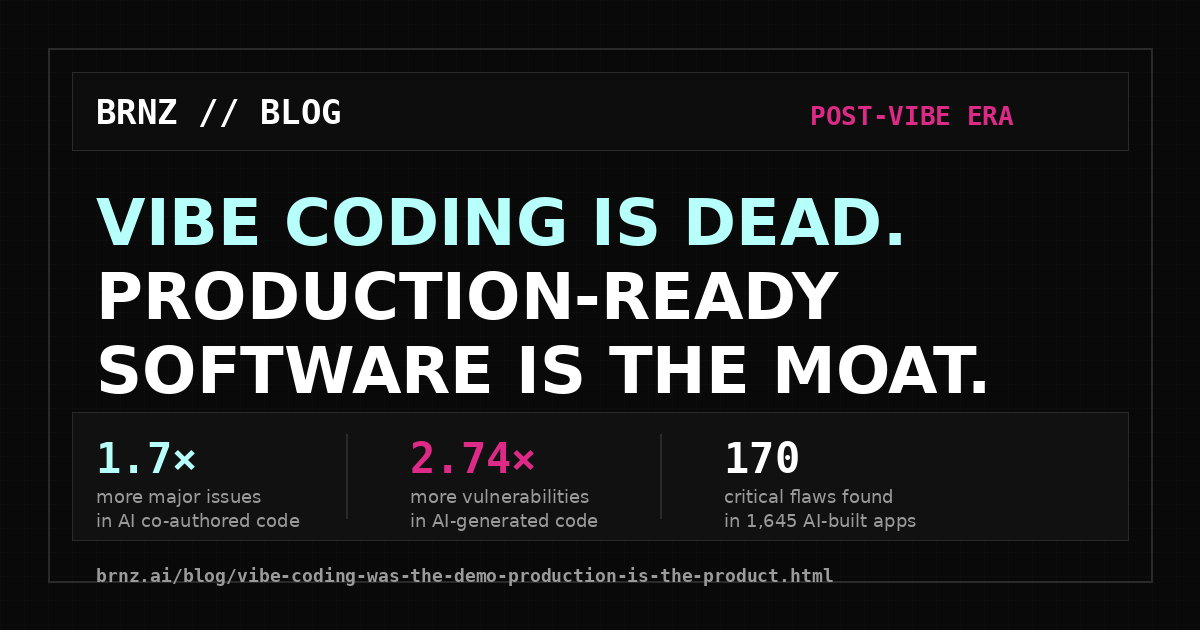
Once AI coding tools moved from toy demos into real apps, the quality problem became measurable. One analysis of 470 open-source GitHub pull requests found AI co-authored code contained 1.7 times more major issues than human-written code. Misconfigurations were 75% more frequent. Security vulnerabilities appeared at 2.74 times the rate.
That matters because the next market is not about who can generate code fastest. It is about who can produce secure AI-generated code, review it, test it, and operate it. Security researchers examining 1,645 apps built on Lovable found 170 with critical row-level security flaws, more than 10% of the sample. A separate cross-tool test found 69 vulnerabilities across 15 identical apps, including six critical. The message is brutal and clear: AI can compress build time while simultaneously increasing application security risk.
| Failure Mode | What Vibe Coding Optimized For | What Production Needed |
|---|---|---|
| Architecture | One-shot generation | Explicit system decomposition and boundaries |
| Security | Assume safe defaults | Treat generated code as untrusted input |
| Maintenance | Ship the first working version | Refactor, test, observe, and evolve |
| Ownership | Prompt-level confidence | Human accountability for every deployed path |
| Reliability | Happy-path demos | Real-world edge cases and failure handling |
The right conclusion is not that AI coding failed. It is that naive AI software development failed. Vibe coding gets you to a prototype. Production-ready software still requires engineering discipline.
What Replaces Vibe Coding
AI-assisted development is not going away. It is becoming more valuable. What is dying is the lazy operating model around it. The next phase is not prompt maximalism. It is controlled software production.
The shift is from one-shot generation to strategic decomposition. Strong teams break systems into reviewable components, define data boundaries before generation, write guardrails before prompts, and run generated code through testing and security checks before it touches production.
That is also the core SEO truth a lot of people are missing: the future keyword is not just vibe coding. It is production-ready AI software, AI-generated code security, AI code review, and how to use AI coding tools safely.
The New Discipline: Engineering the Output
Post-vibe development looks less romantic, but much more real.
- Plan before prompting. Serious teams write technical PRDs, define data models, map integrations, and set security constraints before the model starts typing.
- Treat AI code as untrusted. Generated code should enter the same review, scanning, and testing pipeline as code from an unknown contractor.
- Integrate incrementally. Build one component, validate it, understand it, then move to the next. One-shot generation creates systems nobody can debug.
- Preserve architectural ownership. The model can suggest implementations. It cannot own system boundaries, risk decisions, or production accountability.
- Make security first-pass, not cleanup. If security enters after the prototype, you are not moving fast, you are borrowing trouble.
This is also why the best AI-enabled engineers now look more like system directors than coders in the old sense. They are orchestrating models, tools, tests, repositories, scanners, and runtime checks. The code still matters. But judgment matters more.
The Hard Truth for Non-Developers
This is the part many people do not want to hear. AI did not remove the gap between a prototype and a production system. It made the prototype dramatically easier. The gap is still there.
If you built something with Cursor, Bolt, Replit, Lovable, or Codex, that was not a waste. It was useful. You clarified an idea. You learned what the product should do. You made the invisible visible. But if real users are coming, the next requirement is not more vibes. It is either your own technical judgment or access to someone who has it.
Simon Willison’s framing is the cleanest line in this whole debate: if a model wrote every line but you reviewed, tested, and understood it, that is not vibe coding. That is using AI as a typing assistant. The important word there is understood.
- Define the system: PRD, data model, auth model, integrations, failure conditions.
- Generate narrowly: component by component, not whole-company by whole-company.
- Review aggressively: human review, static analysis, dependency checks, permission checks.
- Test like production matters: unit, integration, abuse, and edge-case testing.
- Observe and harden: logs, monitoring, rollback paths, and post-deploy ownership.
How BRNZ Helps You Survive the Post-Vibe Era
If this article hit a nerve, the problem is probably familiar. You can move fast with AI now, but you do not want to ship fragile software, accumulate silent security debt, or wake up to a production mess you cannot debug. That is the real tension in AI-assisted development today.
This is exactly where BRNZ helps. We do not just prompt out demos. We turn ideas into production-ready software with architecture-first planning, scoped AI execution, review loops, security scanning, and deployment discipline. We use AI for speed, but we build like the product will actually matter, because it will.
For founders, operators, and domain experts, that means a very specific outcome: you get the leverage of AI-generated software without betting your business on unreviewed output. We help define the system, decompose the build, pressure-test the logic, harden the stack, and ship something that can survive real users.
- Clarify the system: we define the product, data model, integrations, workflows, and production constraints before generation starts.
- Build with control: AI accelerates implementation, but every major component is scoped, reviewed, and tested before it ships.
- Harden for reality: we close security gaps, reduce maintenance debt, and turn the prototype into something fit for production.
What You Should Do Now
If you are still in experimentation mode, keep going, but stop confusing speed with readiness. If you already have users, revenue, or operational dependence on AI-generated software, you need a harder process now, not a bigger prompt.
The move is simple: let BRNZ audit what you have, map the weak points, and help you turn the thing you vibe-coded into software you can actually trust.
If you want to turn an AI-generated prototype into production-ready software, talk to BRNZ now.
Continue Reading
Previous Article